Tuesday, 14 April 2015

Beyond the Invisible Hand: Groundwork for a New Economics

Read Beyond the Invisible Hand: Groundwork for a New Economics en ligne. book online now. You also can download comics, magazine and also books. Get online Beyond the Invisible Hand: Groundwork for a New Economics today.
Beyond the Invisible Hand: Groundwork for a New Economics

===>> Click Here To Read Book Free<<===

Please follow instruction step by step until finish to get Beyond the Invisible Hand: Groundwork for a New Economics for free. Enjoy It !!


Beyond the Invisible Hand: Groundwork for a New Economics Description

.

One of the central tenets of mainstream economics is Adam Smith's proposition that, given certain conditions, self-interested behavior by individuals leads them to the social good, almost as if orchestrated by an invisible hand. This deep insight has, over the past two centuries, been taken out of context, contorted, and used as the cornerstone of free-market orthodoxy. In Beyond the Invisible Hand, Kaushik Basu argues that mainstream economics and its conservative popularizers have misrepresented Smith's insight and hampered our understanding of how economies function, why some economies fail and some succeed, and what the nature and role of state intervention might be. Comparing this view of the invisible hand with the vision described by Kafka--in which individuals pursuing their atomistic interests, devoid of moral compunction, end up creating a world that is mean and miserable--Basu argues for collective action and the need to shift our focus from the efficient society to one that is also fair.

Using analytic tools from mainstream economics, the book challenges some of the precepts and propositions of mainstream economics. It maintains that, by ignoring the role of culture and custom, traditional economics promotes the view that the current system is the only viable one, thereby serving the interests of those who do well by this system. Beyond the Invisible Hand challenges readers to fundamentally rethink the assumptions underlying modern economic thought and proves that a more equitable society is both possible and sustainable, and hence worth striving for.

By scrutinizing Adam Smith's theory, this impassioned critique of contemporary mainstream economics debunks traditional beliefs regarding best economic practices, self-interest, and the social good.

.

Read Beyond the Invisible Hand: Groundwork for a New Economics complete books online for free. Reading Beyond the Invisible Hand: Groundwork for a New Economics full free books online without downloading.
Looking up to the full article E-Books free download? Here you can read


Beyond the Invisible Hand: Groundwork for a New Economics . You can also read and download new and old full E-Books. Enjoy and relax with full Beyond the Invisible Hand: Groundwork for a New Economics Books Online.

Monday, 13 April 2015

Fifty Major Economists (Routledge Key Guides)

Read Fifty Major Economists (Routledge Key Guides) gratuitment. book online now. You also can download comics, magazine and also books. Get online Fifty Major Economists (Routledge Key Guides) today.
Fifty Major Economists (Routledge Key Guides)

===>> Click Here To Read Book Free<<===

Please follow instruction step by step until finish to get Fifty Major Economists (Routledge Key Guides) for free. Enjoy It !!


Fifty Major Economists (Routledge Key Guides) Info

.

An introduction to the life, work and ideas of the people who have shaped the economic landscape from the sixteenth century to the present day. Now in a third edition, it considers how major economists might have viewed challenges such as the continuing economic slump, high unemployment and the sovereign debt problems which face the world today, it includes entries on:


• Paul Krugman


• Hyman Minsky


• John Maynard Keynes


• Adam Smith


• Irving Fisher


• James Buchanan


Fifty Major Economists contains brief biographical information on each featured economist and an explanation of their major contributions to economics, along with simple illustrations of their ideas. With reference to the recent work of living economists, guides to the best of recent scholarship and a glossary of terms, Fifty Major Economists is an ideal resource for students of economics. 


Steven Pressman is Professor of Economics and Finance at Monmouth University. He has published around 120 articles in refereed journals and as book chapters, and has authored, or edited 13 books, including Women in the Age of Economic Transformation, Economics and Its Discontents, Alternative Theories of the State, and Leading Contemporary Economists.

.

Read Fifty Major Economists (Routledge Key Guides) complete books online for free. Reading Fifty Major Economists (Routledge Key Guides) full free books online without downloading.
Looking up to the full article E-Books free download? Here you can read


Fifty Major Economists (Routledge Key Guides) . You can also read and download new and old full E-Books. Enjoy and relax with full Fifty Major Economists (Routledge Key Guides) Books Online.

Sunday, 12 April 2015

A River Runs Again: India's Natural World in Crisis, from the Barren Cliffs of Rajasthan to the Farmlands of Karnataka

Read A River Runs Again: India's Natural World in Crisis, from the Barren Cliffs of Rajasthan to the Farmlands of Karnataka gratuitment. book online now. You also can download comics, magazine and also books. Get online A River Runs Again: India's Natural World in Crisis, from the Barren Cliffs of Rajasthan to the Farmlands of Karnataka today.
A River Runs Again: India's Natural World in Crisis, from the Barren Cliffs of Rajasthan to the Farmlands of Karnataka

===>> Click Here To Read Book Free<<===

Please follow instruction step by step until finish to get A River Runs Again: India's Natural World in Crisis, from the Barren Cliffs of Rajasthan to the Farmlands of Karnataka for free. Enjoy It !!


A River Runs Again: India's Natural World in Crisis, from the Barren Cliffs of Rajasthan to the Farmlands of Karnataka Info

.
Crowded, hot, subject to violent swings in climate, with a government unable or unwilling to face the most vital challenges, the rich and poor increasingly living in worlds apart; for most of the world, this picture is of a possible future. For India, it is the very real present.

In this lyrical exploration of life, loss, and survival, Meera Subramanian travels in search of the ordinary people and microenterprises determined to revive India’s ravaged natural world: an engineer-turned-farmer brings organic food to Indian plates; villagers resuscitate a river run dry; cook stove designers persist on the quest for a smokeless fire; biologists bring vultures back from the brink of extinction; and in Bihar, one of India’s most impoverished states, a bold young woman teaches adolescents the fundamentals of sexual health. While investigating these five environmental challenges, Subramanian discovers the stories that renew hope for a nation with the potential to lead India and the planet into a sustainable and prosperous future.
.

Read A River Runs Again: India's Natural World in Crisis, from the Barren Cliffs of Rajasthan to the Farmlands of Karnataka complete books online for free. Reading A River Runs Again: India's Natural World in Crisis, from the Barren Cliffs of Rajasthan to the Farmlands of Karnataka full free books online without downloading.
Looking up to the full article E-Books free download? Here you can read


A River Runs Again: India's Natural World in Crisis, from the Barren Cliffs of Rajasthan to the Farmlands of Karnataka . You can also read and download new and old full E-Books. Enjoy and relax with full A River Runs Again: India's Natural World in Crisis, from the Barren Cliffs of Rajasthan to the Farmlands of Karnataka Books Online.

Understanding Global Trade

Read Understanding Global Trade gratuitment. book online now. You also can download comics, magazine and also books. Get online Understanding Global Trade today.
Understanding Global Trade

===>> Click Here To Read Book Free<<===

Please follow instruction step by step until finish to get Understanding Global Trade for free. Enjoy It !!


Understanding Global Trade Info

.

Global trade is of vital interest to citizens as well as policymakers, yet it is widely misunderstood. This compact exposition of the market forces underlying international commerce addresses both of these concerned groups, as well as the needs of students and scholars. Although it contains no equations, it is almost mathematical in its elegance, precision, and power of expression.

Understanding Global Trade provides a thorough explanation of what shapes the international organization of production and distribution and the resulting trade flows. It reviews the evolution of knowledge in this field from Adam Smith to today as a process of theoretical modeling, accumulation of new empirical data, and then revision of analytical frameworks in response to evidence and changing circumstances. It explains the sources of comparative advantage and how they lead countries to specialize in making products which they then sell to other countries. While foreign trade contributes to the overall welfare of a nation, it also creates winners and losers, and Helpman describes mechanisms through which trade affects a country's income distribution.

The book provides a clear and original account of the revolutions in trade theory of the 1980s and the most recent decade. It shows how scholars shifted the analysis of trade flows from the sectoral level to the business-firm level, to elucidate the growing roles of multinational corporations, offshoring, and outsourcing in the international division of labor. Helpman’s explanation of the latest research findings is essential for an understanding of world affairs.

.

Read Understanding Global Trade complete books online for free. Reading Understanding Global Trade full free books online without downloading.
Looking up to the full article E-Books free download? Here you can read


Understanding Global Trade . You can also read and download new and old full E-Books. Enjoy and relax with full Understanding Global Trade Books Online.

Saturday, 11 April 2015

Capitalism from Below: Markets and Institutional Change in China

Read Capitalism from Below: Markets and Institutional Change in China gratuitment. book online now. You also can download comics, magazine and also books. Get online Capitalism from Below: Markets and Institutional Change in China today.
Capitalism from Below: Markets and Institutional Change in China

===>> Click Here To Read Book Free<<===

Please follow instruction step by step until finish to get Capitalism from Below: Markets and Institutional Change in China for free. Enjoy It !!


Capitalism from Below: Markets and Institutional Change in China La revue

.
More than 630 million Chinese have escaped poverty since the 1980s, reducing the fraction remaining from 82 to 10 percent of the population. This astonishing decline in poverty, the largest in history, coincided with the rapid growth of a private enterprise economy. Yet private enterprise in China emerged in spite of impediments set up by the Chinese government. How did private enterprise overcome these initial obstacles to become the engine of China's economic miracle? Where did capitalism come from?

Studying over 700 manufacturing firms in the Yangzi region, Victor Nee and Sonja Opper argue that China's private enterprise economy bubbled up from below. Through trial and error, entrepreneurs devised institutional innovations that enabled them to decouple from the established economic order to start up and grow small, private manufacturing firms. Barriers to entry motivated them to build their own networks of suppliers and distributors, and to develop competitive advantage in self-organized industrial clusters. Close-knit groups of like-minded people participated in the emergence of private enterprise by offering financing and establishing reliable business norms.

This rapidly growing private enterprise economy diffused throughout the coastal regions of China and, passing through a series of tipping points, eroded the market share of state-owned firms. Only after this fledgling economy emerged as a dynamic engine of economic growth, wealth creation, and manufacturing jobs did the political elite legitimize it as a way to jump-start China's market society. Today, this private enterprise economy is one of the greatest success stories in the history of capitalism..

Read Capitalism from Below: Markets and Institutional Change in China complete books online for free. Reading Capitalism from Below: Markets and Institutional Change in China full free books online without downloading.
Looking up to the full article E-Books free download? Here you can read


Capitalism from Below: Markets and Institutional Change in China . You can also read and download new and old full E-Books. Enjoy and relax with full Capitalism from Below: Markets and Institutional Change in China Books Online.

Four Fish: The Future of the Last Wild Food

Read Four Fish: The Future of the Last Wild Food en ligne. book online now. You also can download comics, magazine and also books. Get online Four Fish: The Future of the Last Wild Food today.
Four Fish: The Future of the Last Wild Food

===>> Click Here To Read Book Free<<===

Please follow instruction step by step until finish to get Four Fish: The Future of the Last Wild Food for free. Enjoy It !!


Four Fish: The Future of the Last Wild Food Description

.
Our relationship with the ocean is undergoing a profound transformation. Just three decades ago nearly everything we ate from the sea was wild. Today rampant overfishing and an unprecedented biotech revolution have brought us to a point where wild and farmed fish occupy equal parts of a complex and confusing marketplace. We stand at the edge of a cataclysm; there is a distinct possibility that our children’s children will never eat a wild fish that has swum freely in the sea. In Four Fish, award-winning writer and lifelong fisherman Paul Greenberg takes us on a culinary journey, exploring the history of the fish that dominate our menus ― salmon, sea bass, cod, and tuna ― and investigating where each stands at this critical moment in time. He visits Norwegian megafarms that use genetic techniques once pioneered on sheep to grow millions of pounds of salmon a year. He travels to the ancestral river of the Yupik Eskimos to see the only Fair Trade–certified fishing company in the world. He makes clear how PCBs and mercury find their way into seafood; discovers how Mediterranean sea bass went global; challenges the author of Cod to taste the difference between a farmed and a wild cod; and almost sinks to the bottom of the South Pacific while searching for an alternative to endangered bluefin tuna. Fish, Greenberg reveals, are the last truly wild food ― for now. By examining the forces that get fish to our dinner tables, he shows how we can start to heal the oceans and fight for a world where healthy and sustainable seafood is the rule rather than the exception.
Paul Greenberg on Four Fish: Fix the Farm, Not the Salmon
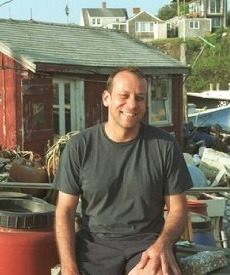
When the New York Times reported in June of 2010 that the US Food and Drug Administration was “seriously considering” approving a genetically modified Atlantic salmon for American consumption the cries from environmentalists and food reformers were, predictably, almost audible on the streets. The AquAdvantage® Salmon uses a “genetic on-switch” from a fish called an ocean pout (a very different animal) in combination with a growth gene from a Chinook salmon to achieve double the growth rate of the unmodified creature. The animal’s creator, AquaBounty Technologies of Waltham, MA asserts that the fish will be sterile and grown in out-of-ocean bio-secure containment structures. Nevertheless the emotional worry of genetic contamination of wild fish, the public preoccupation with health risks a modified salmon could pose, and just the overall ick-factor consumers seem to have about GMO food were all on display across the foodie and environmental blogosphere a few days after the Times article ran.

But, curiously, perhaps the loudest groan that I heard in response to the AquaBounty successes came from salmon farmers. “What I have been noticing over the years,” Thierry Chopin, an aquaculture researcher based in New Brunswick, Canada wrote me, “is that the aquaculture industry is not jumping to embrace what AquaBounty has been proposing.” For years salmon farmers have been waging a public relations war, trying to gain legitimacy as an industry that could be both profitable and produce more food for a hungry world. When a paper published in the journal Nature in 2000 revealed that it took more than three pounds of wild forage fish to grow a single pound of farmed salmon, the salmon industry responded through selective breeding, increased use of soy and other agricultural products and more efficient feeding practices to lower the wild fish use of farmed salmon to the point where some farms claim to have achieved a fish in-fish out ratio of close to 1 pound of wild fish for 1 pound of farmed salmon. When diseases like infectious Salmon Anemia and parasites like sea lice began to run rampant on salmon farms around the world, some regions, like the Bay of Fundy in Canada, instituted better fallowing and crop rotation practices and appear to have had some success in breaking disease and parasite cycles. But in spite of these improvements, a single mention of transgenic salmon in a major media outlet is enough to spoil whatever gains the industry has made in public perception. Indeed, many lay-people I talk with have the impression that transgenic salmon are already a regular part of the farmed salmon market, this despite the fact that there are still no transgenic salmon sold in the United States or anywhere else that I’ve encountered.

Don’t get me wrong. I sincerely do not believe that the salmon industry has solved its environmental problems. But I do think that it suffers an unfair association with the AquaBounty project and that genetic modification distracts from what investment and research really needs to address. The two biggest problems with farming salmon are:

1) Salmon are grown in sea cages, often anchored amidst wild salmon migration routes. This can cause the fouling of waters with wastes and the transmission of diseases and parasites to already seriously threatened and endangered stocks of wild salmon. Selectively bred fish regularly escape and some suggest they may interfere with the lifecycles of wild fish. Even worse, entirely different species of salmon are often raised in non-native environments. Atlantic salmon are regularly farmed in the Pacific and often escape.

2) Farmed salmon consume a huge amount of wild forage fish. Even though feed efficiency on a per fish basis has improved dramatically, salmon farming overall has grown so much that the per-fish efficiency has been all but erased by a much larger overall presence of salmon farming in the world. Atlantic salmon, once limited to the northern latitudes of the northern hemisphere, are now farmed on every single continent save Antarctica. It’s possible farmed salmon escapees may have even reached that most southerly redoubt. Salmon farms exist as far south as Patagonia, South Africa and Tasmania.

So what is the way forward and how do we deal with this transgenic issue? If I were tsar of all salmon farming and could redirect investment money at will, I might take all of those dollars that go into transgenic research and put that money into really confronting the problems that plague the industry. I might look to developing efficient, above ground, re-circulating aquaculture systems. These facilities allow fish to be grown in temperature-controlled environments without any interaction with the wild. Disease transfer and genetic pollution are greatly reduced if not eliminated altogether. Yonathan Zohar a professor and Chair of the Department of Marine Biotechnology at the University of Maryland Baltimore County's has created a test facility right in downtown Baltimore that grows an array of species and even manages to recycle the fish wastes into fuel-grade methane gas that can be used to run pumps or heat water. Though these systems are energy intensive the ability to build them in proximity to markets lessens food miles. Furthermore recirculating systems offer precisely controlled growing conditions and can bring fish to market in half the time as open sea cages.

I might also try to expand on the work of Thierry Chopin who is piloting a program of Integrated Multi-Trophic Aquaculture or IMTA where mussels, edible seaweeds, and sea cucumbers are grown in conjunction with salmon in a complex polyculture. Rather than just trying to make an artificially efficient modified salmon, Chopin is trying to make a more efficient system where multiple crops radiate out from a single feed source. Because mussels, sea cucumbers and sea weed can all metabolize the wastes from salmon, they have a potential to neutralize and reuse the effluent that has plagued salmon farms in the past.

Another place I might put my salmon dollars would be the development of alternative feeds that are synthesized from soy and algae and might eventually obviate the need for using wild forage fish in salmon feed.

Finally, I might consider investing in a different fish altogether. Some critics of the aquaculture industry believe we should do away with the farming of salmonids altogether. But to my eye, there is a very entrenched market for salmon flesh and we might be better served finding a different salmon-like fish that has a smaller footprint. The most hopeful alternative I’ve come across is a fish called the arctic char. The arctic char is from the same taxonomic family as salmon, has pretty good feed conversion ratios, rich flesh, and most interestingly of all, because it frequently finds itself crammed into close quarters when its natural arctic lakes freeze, it has high disease resistance and takes extremely well to high stocking densities—densities that are necessary to make out-of-ocean aquaculture operations profitable. And this is exactly what’s happening with char. Most are grown in re-circulating, above ground tanks in Iceland and Canada.

Of course some people will never embrace a farmed solution for fish. There is a camp that feels very strongly that farmed fish are uniformly bad for the world and inferior on the plate. I have to confess that I don’t always share this opinion. Arctic char strike me as a good environmental compromise and to my palate, they’re pretty tasty.

--Paul Greenberg

.

Read Four Fish: The Future of the Last Wild Food complete books online for free. Reading Four Fish: The Future of the Last Wild Food full free books online without downloading.
Looking up to the full article E-Books free download? Here you can read


Four Fish: The Future of the Last Wild Food . You can also read and download new and old full E-Books. Enjoy and relax with full Four Fish: The Future of the Last Wild Food Books Online.

Tangled Roots: The Appalachian Trail and American Environmental Politics (Weyerhaeuser environmental books)

Read Tangled Roots: The Appalachian Trail and American Environmental Politics (Weyerhaeuser environmental books) en ligne. book online now. You also can download comics, magazine and also books. Get online Tangled Roots: The Appalachian Trail and American Environmental Politics (Weyerhaeuser environmental books) today.
Tangled Roots: The Appalachian Trail and American Environmental Politics (Weyerhaeuser environmental books)

===>> Click Here To Read Book Free<<===

Please follow instruction step by step until finish to get Tangled Roots: The Appalachian Trail and American Environmental Politics (Weyerhaeuser environmental books) for free. Enjoy It !!


Tangled Roots: The Appalachian Trail and American Environmental Politics (Weyerhaeuser environmental books) Info

.
The Appalachian Trail, a thin ribbon of wilderness running through the densely populated eastern United States, offers a refuge from modern society and a place apart from human ideas and institutions. But as environmental historian and thru-hiker Sarah Mittlefehldt argues, the trail is also a conduit for community engagement and a model for public-private cooperation and environmental stewardship..

Read Tangled Roots: The Appalachian Trail and American Environmental Politics (Weyerhaeuser environmental books) complete books online for free. Reading Tangled Roots: The Appalachian Trail and American Environmental Politics (Weyerhaeuser environmental books) full free books online without downloading.
Looking up to the full article E-Books free download? Here you can read


Tangled Roots: The Appalachian Trail and American Environmental Politics (Weyerhaeuser environmental books) . You can also read and download new and old full E-Books. Enjoy and relax with full Tangled Roots: The Appalachian Trail and American Environmental Politics (Weyerhaeuser environmental books) Books Online.